गणेश चतुर्थी · Faith · Tradition · Togetherness
Ganesh Chaturthi
A Hindu festival marking the birth of Lord Ganesha, observed on Bhadrapada Shukla Chaturthi — the fourth day of the waxing moon in the lunar month of Bhadrapada. It opens Ganeshotsav, the multi-day celebration during which an idol of Ganesha is installed at home or in a public pandal, worshipped daily, and finally immersed in water. Because it follows a lunar Tithi rather than a fixed date, it falls on a different Gregorian date each year, typically between mid-August and late September.
Next Ganesh Chaturthi
Ganesh Chaturthi 2027 is on Saturday, 4 September — Sthapana before 12:25 PM, Visarjan on 14 September. 2026 dates
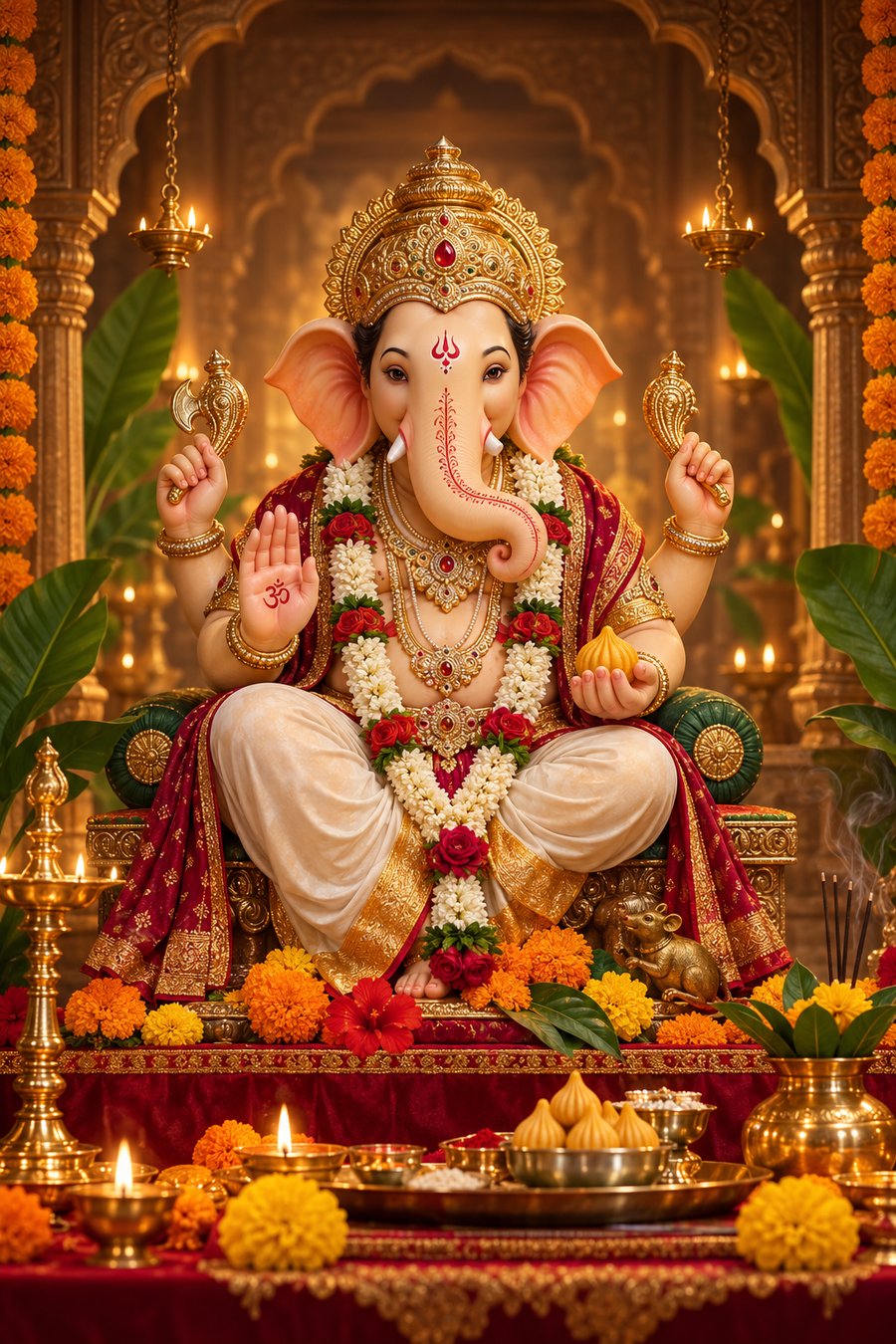
Ganpati Bappa Morya!
Every step of Ganeshotsav, in one guide
Verified dates and muhurat, a puja vidhi a first-timer can follow, the full samagri checklist, authentic modak recipes, eco-friendly idol guidance, and how the festival is celebrated across India — all in one 26-page PDF, with Hindi and Marathi summaries throughout.
The story behind the festival
The most beloved account tells of Goddess Parvati, who, while Lord Shiva was away, wished for a guardian at her door loyal to her alone. She fashioned a boy from turmeric paste and breathed life into him. When Shiva returned and the boy stood firm against him, Shiva — unaware this was Parvati's son — struck off his head. Grief-stricken, Parvati was consoled when Shiva sent his attendants to bring the head of the first living being found facing north; they returned with the head of a young elephant. Shiva placed it on the boy's body and restored him to life — Ganesha, born a second time, whole and blessed to be worshipped before every other deity.
A second well-loved legend explains why Ganesha is Prathama Pujya — "the one worshipped first." The gods once held a race around the universe, with the title of "wisest" promised to whoever finished first. While his brother Kartikeya set off on his peacock, Ganesha simply walked around his own parents and declared the journey complete — for to him, his mother and father were the entire universe. Moved by his wisdom, Shiva and Parvati declared he would be honoured before any other god in every ritual, a tradition that continues to this day. For how this same story is told differently across the Puranas, and how the festival's public celebration actually began, see Ganesh Chaturthi History.
How Ganeshotsav is celebrated
A brief overview — see the guide for a full step-by-step puja vidhi.
Sthapana
The idol is ceremonially installed, traditionally during the Madhyahna (midday) period — believed to be the hour of Ganesha's own birth.
Daily puja & aarti
Morning and evening aarti, offerings of flowers, durva grass and modak, continue for as many days as the household observes.
Visarjan
The idol is carried in procession and immersed in water, symbolising Ganesha's return home and the cycle of creation and dissolution.
How many days should you keep Ganpati?
The full traditional observance, Ganeshotsav, runs from Chaturthi to Anant Chaturdashi — 10 to 11 days depending on the lunar calendar that year. Many families instead choose a shorter duration to suit their own custom:
| Duration | Also known as | Typically chosen by |
| 1.5 days | Dedh Divas | Nuclear families; a quick, intimate blessing |
| 3 days | Gauri-Ganpati | Households also welcoming Goddess Gauri |
| 5 days | — | A common mid-length family tradition |
| 7 days | — | Extended families, larger home celebrations |
| 10–11 days | Anant Chaturdashi | Public mandals, full traditional observance |
What matters most is the sincerity of the daily aarti, not the number of days. For exact Visarjan dates for each option, see Ganesh Chaturthi 2026 and Ganesh Chaturthi 2027.
What you'll need: the samagri checklist
The essentials: a clay or eco-friendly Ganesha idol, a wooden chowki with red or yellow cloth, a kalash with water, mango leaves and coconut, kumkum/haldi/chandan, akshata, durva grass (21 blades), fresh flowers including red hibiscus, panchamrit ingredients, diya and wicks, agarbatti and camphor, betel leaves and areca nut, jaggery and coconut, fresh modak (ideally 21), seasonal fruits, dakshina, new cloth for the idol, a bell and aarti thali, and rangoli colours for the entrance. Gather everything a few days ahead so Chaturthi morning is calm, not a scramble — our complete guide has this as a tick-off checklist plus the full step-by-step puja vidhi to go with it.
Modak: Ganesha's favourite
No Ganeshotsav table is complete without modak — beloved enough that one of Ganesha's own names, Modakapriya, means "the one who loves modak." The classic Maharashtrian Ukadiche Modak is a steamed rice-flour dumpling filled with coconut and jaggery, traditionally offered 21 at a time during the main puja. Quicker alternatives include fried Talniche Modak and the crescent-shaped Karanji, both made with the same coconut-jaggery filling. Full ingredient lists and step-by-step method — for the filling, the dough, shaping and steaming — are in our complete guide.
Celebrating sustainably
Eco-friendly celebration has moved from a niche preference to an active requirement in many Indian cities, as Plaster of Paris (PoP) idols — which don't dissolve the way natural clay does — settle at the bottom of lakes and rivers rather than truly returning to nature. Clay (Shadu) idols, natural colours, and small-scale immersion (a bucket at home, for instance) are the most common alternatives. Our 2026 guide covers what's changed city by city this year.
One festival, many forms across India
The devotion is the same everywhere; the shape it takes changes state to state. Maharashtra's public Ganeshotsav — the form most of India recognises today — took shape when Lokmanya Tilak turned a home festival into a mass community celebration in 1893; Mumbai's Lalbaugcha Raja is its most famous modern expression. Telangana and Andhra Pradesh celebrate Vinayaka Chavithi, home to Hyderabad's towering Khairatabad Ganesh. Karnataka pairs the festival with Gowri Habba as Gowri-Ganesha. Tamil Nadu's Pillaiyar Chaturthi centres on home worship, kolam designs, and kozhukattai — the South Indian cousin of modak. Goa's Chovoth is distinctive for the matoli, a canopy of local harvest produce built over the idol. And communities from New Jersey to London to Dubai now hold their own Sthapanas and processions abroad. See the full story of how this became a public festival on our History page.
The Complete Celebration Guide
Everything above — and much more — in one PDF
26 pages covering dates & muhurat, the full story, puja vidhi, samagri checklist, modak recipes, eco-friendly guidance, regional traditions, Vastu & idol placement, decoration ideas, the twelve names of Ganesha, an FAQ chapter, and wishes to share — with Hindi and Marathi summaries throughout.
Buy Now — ₹99 →Related pages
Ganesh Chaturthi 2026
This year's exact dates, muhurat and calendar.
Ganesh Chaturthi 2027
4 September — short Sthapana muhurat, Visarjan 14 September.
Ganesh Chaturthi History
From ancient worship to a national festival.
Ganesh Chaturthi Wishes
Messages to share for the festival.
Name & Meaning
The Sanskrit origin of the festival's name.
Shop
Calendars and devotional guides.
Frequently asked questions
What is Ganesh Chaturthi?
A Hindu festival marking the birth of Lord Ganesha, observed on Bhadrapada Shukla Chaturthi. It opens Ganeshotsav, the multi-day celebration during which an idol is installed, worshipped daily, and ceremonially immersed at the close.
Why is Ganesha worshipped first, before other deities?
Per a well-loved legend, the gods once raced around the universe for the title of wisest. Ganesha simply walked around his own parents, declaring the journey complete since they were his entire universe — earning him the title Prathama Pujya, "the one worshipped first."
How long does Ganesh Chaturthi last?
The full traditional observance, Ganeshotsav, runs 10–11 days, Chaturthi to Anant Chaturdashi. Families commonly choose shorter durations — 1.5, 3, 5 or 7 days — based on personal custom.
When does Ganesh Chaturthi fall each year?
It follows a lunar Tithi rather than a fixed date, so it shifts every year, typically falling somewhere between mid-August and late September. In 2027 it falls on Saturday, 4 September — see Ganesh Chaturthi 2027.